Stranded or Fungible?
Extropic’s thermodynamic hardware rests on a bet: that its energy-based-model advantage is stranded, that locality keeps pace with scale so commodity silicon can’t erase the edge. I built an instrument to test that bet. On the axis it can measure, the moat looks more like a head start.
On the axis this study can measure, the sampler’s advantage is bought with connectivity and mixing time, and commodity silicon pays those same bills or amortizes them into stored weights. Nothing here is owned; it is rented, in currencies GPUs also carry. That is a leaning, not a proof, and it stays silent on the one thing that would make the edge a real moat: physical energy, which this study never measures.
Thermodynamic computing is one of the more interesting frontier bets in hardware. The pitch is that sampling from a probability distribution, the operation underneath a lot of generative AI, is something physics does for free if you build the right analog device, and that this yields an enormous energy advantage over pushing the same samples through a GPU. Extropic is the sharpest expression of the bet, with a claimed edge measured in multiples that would reorder the economics of AI compute.
The question I care about is not whether the physics is real. It is whether the advantage is a moat or a head start. A moat is an edge built on something commodity silicon cannot buy: locality keeps pace, the analog device stays ahead, and no amount of GPU spend closes the gap. A head start is an edge silicon simply hasn't bothered to copy yet: quality increasingly needs long-range wiring, or the sampler bogs down in mixing time as problems grow, so the lead is paid for in currencies GPUs also pay, and it shrinks to nothing on real workloads. The study's terms for the two are stranded and fungible. In plainer words: does the edge stick, or does silicon eat it?
So I built an instrument. It simulates the sampling algorithm and measures how quality and correlation-reach trade against mixing cost as connectivity and scale vary. One caveat sits above everything and I will not bury it: every number here is algorithm behavior, not physical energy. The headline energy claim is a hardware output this study can neither confirm nor deny. The leaning is on the mapping, and it is explicitly silent on silicon joules.
- 01
Locality does not keep pace with scale.
As the model grows, nearest-neighbour sample quality falls (0.587 → 0.556 → 0.486), and the connectivity range needed to hold a fixed quality grows. On a single machine, reaching target quality increasingly demands longer-range wiring.
- 02
The architecture’s own escape hatch does not rescue it.
Chaining several samplers together does not convert the connectivity requirement into a depth requirement: the minimum range for target quality is flat in chain depth. It buys a real but bounded gain, not a substitute for reach.
- 03
The locality tax shows up in the physics.
A calibrated measurement (it correctly recovers the known 2D-Ising exponent) finds steep critical slowing, the cost paid in mixing time, while the information light-cone speed rises with range, the cost paid in wiring. Both routes to long-range correlation are taxed, exactly as the currency-of-correlation thesis predicts.
- 04
Forcing categorical problems onto local binary spins is taxed.
Encoding the codon task onto local spins costs 2.66× the spins, adds pure-constraint overhead, and needs 10 to 25× the sampling budget to reach validity. The mapping itself is expensive before any hardware advantage is counted.
- 05
And the reframe that settles most of it: the substrate question only bites on irreducible workloads.
The advantage can only matter where no learned change of coordinates makes the correlations short-range. The study’s own headline workloads are not in that set: a learned latent collapses MNIST’s structure, and the codon task is already a 1D chain. For those, software wins by construction. On the one synthetic workload that is genuinely irreducible, the cross-substrate ledger below shows every hardware-realizable substrate paying at least as much as learned-representation-on-silicon. Nothing measured is meaningfully flatter than commodity silicon.
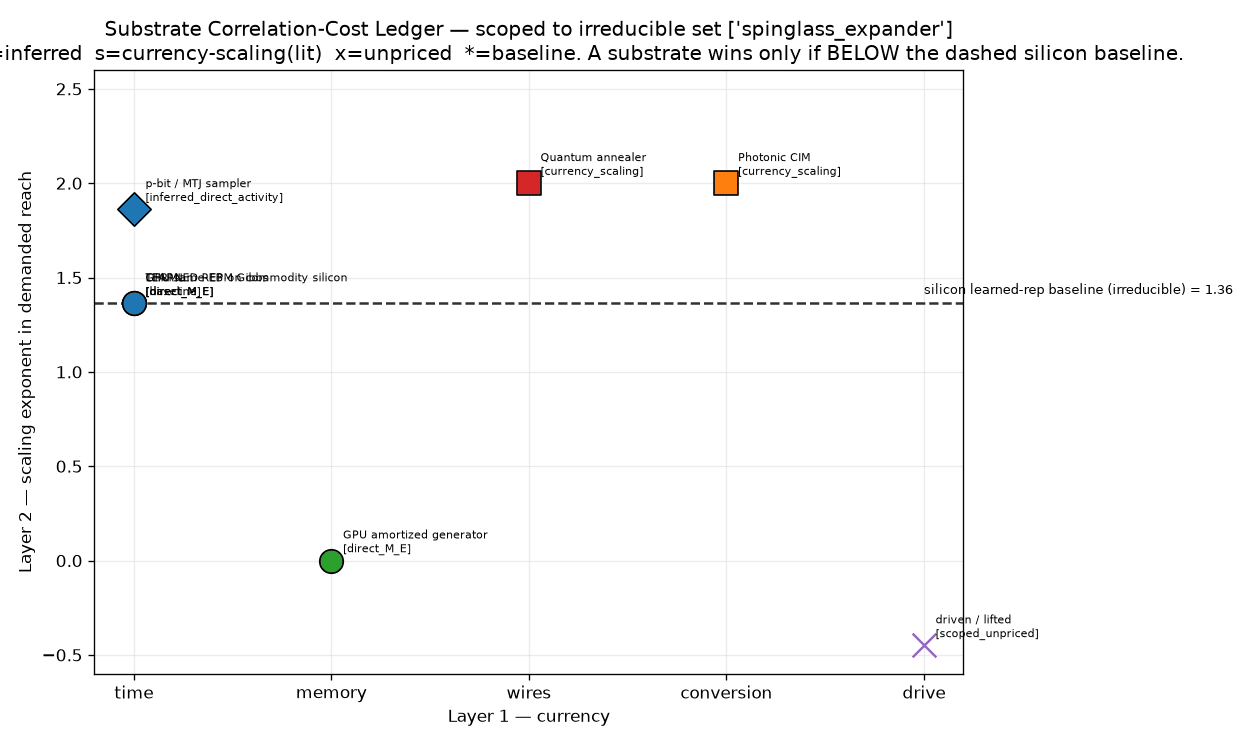
This is a leaning, so I am naming exactly where it could break, because the decisive cells are the ones I could not measure.
- 01
The full-scale locality ceiling.
The shape is there up to mid-range reach. The full-decade version needs GPU escalation I have not run. A clear absence of the ceiling at large scale would weaken the read.
- 02
The driven escape.
Lifting the sampler collapses autocorrelation (about 19× on a control), but whether that is a genuinely lower exponent, whether it survives its own entropy cost, and whether it beats a GPU running the same trick, is unpriced. A real sweet spot there would be a stranded signal.
- 03
Native long-range substrates.
This measures one architecture. A substrate with real analog long-range physics and no conversion tax could pass where engineered-up wiring fails. It is out of frame here.
- 04
Energy is never measured.
Every cost here is simulation compute, not silicon joules. The hardware’s claimed near-free physical step, if it is real, would forgive the mixing-time tax entirely. That is the whole ballgame, and it is a hardware ledger this study cannot price.
The equilibrium instrument leans fungible, the escape hatch does not overturn it, and on the only workloads where the substrate question actually matters, nothing measured beats commodity silicon in its own currency. But the cells that could still flip it are the ones I could not measure, and the biggest of them, physical energy, is the exact thing the hardware is selling.
So I am skeptical the moat is as wide as claimed. I am not claiming it is zero, and I have marked precisely what I would need to see to change my mind. That is the honest shape of it: no stranded candidate appears in the cells I could reach, every hardware-realizable path pays steeply in its own currency, and the one currency that would forgive all of it is the one I never got to price.